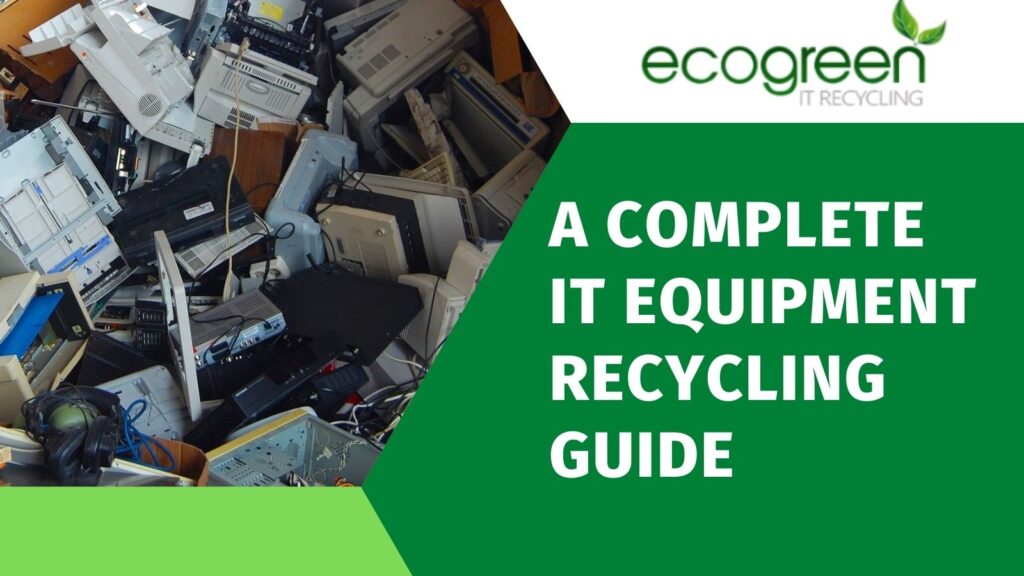
IT equipment recycling might not be a popular term for many people, but it is becoming more and more relevant every day because of the climate change threat. Thankfully, we are not talking about the Stephen King horror novel ‘it’ here, although IT equipment recycling deals with plenty of other horrors.
As the consumption of electronics around the world increases, so does e-waste (electronic waste), which is a grave threat to the environment. Almost 20 to 50 million metric tons of e-waste are discarded every year, and only 12.5% of it is recycled.
Is IT Equipment Recycling Worth It?
 IT recycling deals with your old computer parts, abandoned smartphones, and redundant electrical equipment, and recycles them to provide you with a greener future. Here’s why IT equipment recycling is necessary,
Reducing Dumped Electronics
E-waste comprises old computers, laptops, cellphones, hard drives, and other electronic equipment, much of which is thrown away to the dumps as newer and better products take over the market.
Minimising Landfills
Most of these gadgets and appliances fill up landfill sites, taking up vast amounts of space, and creating tons of pollution. Electronic recycling of older and unusable products to manufacture newer ones is a much greener and efficient solution, especially when the future of the world is at stake.
Recovery of Valuable Parts
Many old computer parts and electronic gadgets can often become unusable due to their short lifespan, but not all parts of the gadget are useless. The IT equipment may contain many valuable parts and materials that can be recycled and used for the production of newer items.
Proper Disposal of Harmful Materials
Today, the global electronics market is growing at a fast pace. However, the expansion of the market comes at a cost of wasted electronic parts that could go for IT recycling. Only 20% of e-waste is recycled at present, and the rest are either incinerated or dumped at landfill sites.
The harmful waste can also seep into the water and be consumed by humans, which can lead to a variety of illnesses. Therefore, with correct recycling techniques, the proper disposal of toxic substances is ensured. Proper IT equipment Recycling processes are required, and to ensure the items are segregated and all IT equipment is disposed of securely and safely.
Creating Employment Opportunities
Some broken computer parts and electronic gadgets are beyond repair and need to be sent to recycling plants to be adequately processed. These electronic recycling plants require human resources – to sort e-waste, run the plants, and oversee them.
As a result, the more people in a community are involved in e-waste recycling, the more jobs it creates. So, instead of dumping electronic waste products straight into the trash, they could be sent into a recycling plant instead.
Supporting Local Communities
Not all computers need to be broken down into pieces and built up again from scratch. Many consumers discard their old products to stay updated with the recent technology, or when their old products do not fit the requirements for their job requirements anymore.
IT equipment Recycling is an industry that is versatile and encourages news technology for the latest systems and processes within companies’ frameworks. A large portion of landfill sites consists of these computer parts. However, there are alternative solutions. Some recycled computers, which are still in working condition, can be reconditioned to be usable again.
What Materials are Found in Computers?
 Computer equipment can consist of a variety of components. These may include larger devices such as monitors, printers, and hard drives, as well as internal circuitry such as motherboards and power supplies. Most of these components are made from metals, plastics, and glass. Roughly about 23% of a standard computer consists of plastic. Another 15% of a PC is made up of glass.
The rest of it comprises ferrous metals (32%), non-ferrous metals (18%), and electronic circuitry (12%). Most of these materials are recyclable, as long as the components are discarded and appropriately sorted.
Read this article to know How to recover data from broken phone in a simple and easy way.
What Computer Parts Can Be Reused?
If your computer is worn out but functional, you have the choice to repurpose it. Most computer parts can be reused if they are useful. For example, if your business has a computer whose processor has slowed down over years of use, you can use it to run low-intensity programs that your business might need, such as word processors.
You could also choose to repurpose individual components. For instance, you could go with some additional cheap equipment, or you can convert your internal hard drive into an external one. Similarly, if you have perfectly functional RAM, you can remove it from your old computer and install it into a new one.
You can also choose to donate your computers and equipment to impoverished communities and local charities, and help support them. However, often for large businesses, taking these actions on their own is time-consuming and infeasible, which makes using a third-party like EcoGreen IT Equipment Recycling a viable choice.
Which Parts of a Computer Can Be Recycled?
There are several parts of a computer that can be recycled and reused. Instead of just throwing these parts out, you can extend their lifetime.
CMOS Battery
The CMOS (Complementary Metal Oxide Semiconductor) battery, also known as non-volatile RAM, is one of the most toxic and hazardous components in your computer.
The battery provides power to the computer to hold some values such as the date and time that the system might need when it gets rebooted. Although small, the CMOS battery is an alkaline battery made up of lithium, which is extremely explosive and reactive, and requires great care when recycling.
Motherboards
The motherboards act as the nervous system of your computer. They connect many of the essential parts that make up a computer, such as the CPU, the memory unit, and the slots for input and output devices.
Within the electronic Recycling industry, the motherboards are a primary source of precious metals, especially for the extraction of gold. Consisting of complex circuits, motherboards contain traces – thin layers of copper or aluminium printed on some form of rigid plastic.
The boards also comprise other highly conductive, valuable elements such as gold and silver, and all the components are connected with lead-based solder. Therefore, when recycled, a large number of metallic materials can be collected from motherboards alone.
CPU
CPU (Central Processing Unit) is the brain of your computer. When you’re typing a sentence using your keyboard, or clicking on an icon, or even reading this text – the information passes through your CPU.
For an IT equipment Recycling firm, the processor is the most crucial part of the extraction of precious metals such as gold. The CPU then sorts the data and makes calculations that allow your computer to function correctly. The CPU does this by using silicon – a semiconductor that can switch on and off depending on the voltage applied to it.
Besides silicon, CPUs are also a source of gold and other precious metals. However, recycling CPUs is a complex process, and it involves the use of hazardous chemicals and intricate tools. Great care must be taken when recycling a CPU, and should only be done by professionals.
Hard Drive
How does a computer know where your files are stored? The secret lies within the hard drive, which stores all your digital content such as your documents, pictures, programs, and the operating system.
The data on the hard drive is stored on a hard magnetic disk. The disk is usually made from glass, ceramic, or aluminium, and then coated with a thin layer of ferrous metal that can be magnetized or demagnetised. Many hard drives can be reused, by overwriting and erasing existing data.
However, if your hard drive is physically damaged or broken, you can send it off for computer equipment recycling. The drive is shredded, and then the aluminium, magnets, and circuit boards are separated to be used for producing newer components.
You can also destroy the hard drive, read here: What’s The Best Way Of Destroying A Hard Drive?
Optical Drive
As alternate forms of storage such as flash drives and cloud computing become more popular, fewer computers now come with optical drives for CDs and DVDs. PCs that come with optical drives are usually out-of-date, which is all the more reason you might be sending them for IT equipment recycling.
The optical disc drives work by sending a small form of laser light to read or write on optical discs, which are made from acrylic and covered with a thin layer of silver or gold. The disc drive itself consists of a plastic housing, and copper wire coils that create a magnetic field to suspend the laser. The drives also contain other useful materials such as steel and aluminium, all of which can be recycled.
Cables
Hopefully, there is no need to explain what cables do! Cables are the most familiar of all electrical equipment. Faulty wiring or damaged cables can often be a cause of exasperation, and if you’re not sure how to dispose of them, they might add up to take large spaces in your office storage.
Most computer cables are made from metals such as copper, as they are the most flexible and provide very little electrical resistance. However, some of the more sensitive components of a computer can contain cables plated with gold, as it makes them corrosion-proof. So, cables can be a rich source of metals as well. In an IT equipment recycling facility, they are crushed and peeled to separate the copper, and the plastic insulation and can have an efficiency of up to 99.9%.
How Does the IT Equipment Recycling Process Work?
By this point, you’re probably quite interested in the whole process of IT recycling. And you must be wondering what it is done!.
Usually, the exact process of computer waste Recycling equipment varies from company to company, and from component to component. However, the general procedure that most recycling plants follow remains the same.
Pre-Processing
At first, the old computer parts and electronic equipment are collected from the businesses based on the clients’ needs. The items received are then sorted and pre-processed. There are two ways to go about this.
The items received can be reported by weight, which involves weighing the items as they are received and removing hazardous components manually. Sometimes, the components received are also reported by item, in which case, the pieces are weighed as well as scanned and sorted separately.
Removal of Hazardous Substances
Once all the equipment has been correctly received and collected, they now need to be sorted so that hazardous materials are removed. Some of the hazardous components you can find in electronic devices include batteries, ink cartridges, mercury bulbs, and cathode-ray tubes found in monitors. The separated harmful components are then disposed of properly in an environmentally sound manner.
Readmore: What You Need To Know About Disposing Of Hazardous Substances And Materials?
Shredding
Once all the hazardous and toxic substances have been removed from the electrical components, the actual e-waste recycling process begins. The computer equipment is fed into a shredder using a conveyor system, which breaks down all the equipment into large chunks of 2” to 6” inches in diameter.
Although most parts of the process are automated, manned support is still required to oversee the process and to take control during emergencies. Besides, manual assistance is also necessary for services such as hard drive destruction, asset repair, and disposal of waste items.
Sorting
After the different devices and equipment have been shredded, the resultant e-waste is a mixture of several metals like iron, aluminium, and copper, plastics, and circuit boards. The next step in the process is sorting and separating these different elements.
To collect iron and steel from computer equipment, the e-waste is passed through powerful magnets, which collect the materials into bags. The e-waste keeps moving along the conveyor belts, and non-ferrous metals such as aluminium and copper are separated next.
The process of sorting them is more complicated than that of ferrous metals and may require visual inspection and manual involvement to yield better results. The remaining e-waste consists mostly of plastic, which is further separated using advanced technology. The separated plastic goes through another advanced metal removal process, to increase the purity of the plastic materials and remove any metallic residue.
What Happens to IT Recycled Products?
Most of the products that are collected from the e-waste stream are used to make newer products. The metals collected, such as steel, aluminium, and copper, are used as raw materials to make new electronic devices. Similarly, the glass in computer monitors, tablets, and other screens are separated from lead and used for manufacturing newer products.
The plastics from various computer equipment are also broken down into flakes and pellets for further use. These broken-down substances are collected in pellet sacks or cardboard boxes. They are then shipped to another computer recycling plant for further purification or sent directly to a manufacturer. The manufacturer uses these items as raw materials to produce newer and better products, resulting in reduced carbon emission and energy consumption, and creating a greener earth.
Why Does EcoGreen IT Recycling UK Stand Out?
You’ll find plenty of IT Recycling companies in the UK who could promise you an outstanding service. But, there are some factors why EcoGreen IT Recycling stands out among them.
IT Equipment Recycling Services (B2B)
EcoGreen IT Recycling provides a myriad of services that makes them a suitable choice for you when it comes to IT equipment Recycling. EcoGreen computer Recycling follows ethical and legal procedures when disposing of your computer equipment, ensuring that you and your data remain safe and secure.
For starters, we collect disposed electrical equipment from your business offices and locations within 24-72 hours. We follow the WEEE (Waste Electrical and Electronic Equipment Directive) directive to remove and destroy your data.
The data in your hard drives are deleted using degaussing, shredding, or hard drive crushing. In data degaussing, the magnetically stored information on your hard drives is neutralized using a degaussing machine. After the destruction of data, EcoGreen offers you a certificate of destruction and proof, relieving you from your woes about your private information.
Pick-Up From Location
If you’re looking for the best computer recycling companies near you in the UK, EcoGreen is your best bet for the most convenient and burden-free experience. EcoGreen IT Recycling UK collects old computer parts and other electronic equipment from businesses all around the nation.
After the client provides us with a list of items that need to be disposed of, we collect the items within 24-72 hours and analyze whether the items should be reused or recycled. The items are collected using satellite-tracked vehicles to ensure that your equipment reaches our destination safely and securely. Our services include Free Business Collection for businesses.
And for several items less than 20, we still encourage our clients to get in touch so that we can attempt to assist them. Ecogreen IT Equipment Recycling has offices in London, Bristol, and Birmingham and our headquarters is located in Nottingham.
Readmore: Local Recycling: 7 Ways to be a Better Recycler in the UK
Policies
EcoGreen electronics Recycling takes its commitment to its clients very seriously. We attempt to ensure that you receive the best of our service and can provide you with maximum satisfaction. Our collection procedures and recycling facilities aim to be environmentally friendly and of the highest quality, which is why we are ISO 9001 Quality Management systems and ISO 14001 Environmental systems certified.
As an IT equipment recycling company, EcoGreen is committed to minimising the damage to the environment. Our environmental policy aims to reduce the production of waste and reduce the wastage of materials and energy as much as possible. We also aim to subside pollution and noise emissions due to our operations.
Environment-friendly Recycling
For customers around the United Kingdom, EcoGreen IT Recycling offers WEEE recycling and disposal for old computer parts, redundant IT Recycling equipment, and other electronic items.
The WEEE (Waste Electrical and Electronic Equipment) Directive was introduced into the UK Law in January 2007 to encourage citizens to reuse, refurbish, and recycle IT equipment. EcoGreen IT Recycling is compliant with the WEEE Directive and thus is licensed by the Environmental Agency.
Bottom Line
To conclude, as tempting as it seems to dump your electrical waste equipment in the trash or a landfill site, IT equipment Recycling is much more worth it. Every year in the UK alone, we throw away enough electronic waste to fill the Wembley Stadium six times over.
Only through proper electronic recycling procedures can we help minimize the e-waste and the toxic substances that seem to have taken over our landfill sites and water supplies. We need to be responsible on how to manage our discarded computer products and IT Recycling equipment, and EcoGreen IT Recycling makes playing your part much more convenient for you.