
If there is one thing all businesses do, it is process and store sensitive information. Businesses hold trade secrets, sensitive contracts, customer information and private information about employees. Much of it is kept on computers, but not all of it.
Paper is still a relevant storage medium in many industries. Businesses have printed reports, contracts and files that should be kept confidential. When these documents reach the end of their life, they must be destroyed securely to prevent data leaks. That is where a confidential paper shredding service comes in.
Got confidential paper to destroy? Get a free quote or book a collection, or call 033 0124 3053.
Data breaches are not always digital
The modern age has given us a hyper-connected digital world, so it is easy to overlook the importance of protecting physical documents. But businesses must make sure sensitive documents are disposed of securely. It is a necessity in terms of both law and ethics.
The results of failing to protect sensitive paper documents are the same as the results of failing to protect digital information: data breaches, regulatory action and reputational harm.
What is confidential paper shredding?
Confidential paper shredding, also called confidential document shredding, is the secure destruction of sensitive paperwork so that nobody can read or reassemble it. It covers anything from employee files and legal contracts to customer data and financial records. Typical documents include:
- Financial records, bank statements, invoices and tax records
- Personnel files, payslips, CVs and job applications
- Customer data and correspondence
- Contracts, agreements and legal papers
- Medical records
- Meeting notes, plans and internal reports
What counts as confidential waste?
Confidential waste is any document that identifies a person or reveals sensitive business information. If it fell into the wrong hands, it could be used for fraud or identity theft, or used against your business. It usually falls into two groups.
Personal data
This is information that can identify a living person, such as a customer, a supplier or a member of staff. It is covered by UK GDPR and the Data Protection Act 2018. Examples include:
- Bank and card details
- Staff performance and HR records
- Medical information
- CVs and job applications
- Home addresses, phone numbers and signatures
Confidential business information
This information does not identify a person, but it could still harm your business if a competitor or criminal got hold of it. Examples include:
- Legal documents
- Strategy documents and budget data
- Payment schedules and invoices
- Product development data
- Passwords and system details
If you would not want a stranger to read it, treat it as confidential waste.
The hidden risks of ignoring paper shredding
So what can happen if you do not shred your documents properly? There are good reasons why businesses should not see shredding as an extra hassle.
1. Legal consequences
UK GDPR requires organisations to keep personal data secure, including when it is thrown away. The Information Commissioner’s Office (ICO) can take action, including fines, against organisations that do not take information security seriously.
2. Information security risk
If discarded records end up in the wrong hands, the risk of identity theft and fraud goes up. Anyone who finds old documents in a bin or skip can use them against you or your customers. A professional paper shredding service removes that risk.
3. Loss of trust
A single data breach is enough to lose the trust of customers and employees. They expect their information to be safe with you. A breach can damage your reputation, your sales and your professional relationships.
4. Clutter and inefficiency
Unnecessary paperwork takes up valuable office space and makes it harder to stay organised. Regular secure shredding keeps your workspace tidy and frees up storage you may be paying for.
5. Environmental impact
Confidential paper should not go into general waste or landfill. Once it has been shredded, it can be recycled into new paper products, which is the more sustainable choice.
UK laws on confidential paper disposal
UK businesses must follow the rules on how confidential information and business waste are handled. The main ones are:
- UK GDPR. It covers personal data held in organised paper filing systems, not just digital files. Two principles matter most: keep personal data no longer than you need it, and protect it against unauthorised access. See the ICO’s guide to the data protection principles.
- Data Protection Act 2018. It sits alongside UK GDPR and sets out how it applies in the UK.
- Waste duty of care. Confidential paper is also business waste, so you must only pass it to someone authorised to take it, and keep the paperwork. See the GOV.UK waste duty of care code of practice.
- Simpler Recycling. Since 31 March 2025, most workplaces in England with 10 or more employees must separate their recycling, including paper and card. Smaller workplaces have until 31 March 2027. See the GOV.UK guidance on Simpler Recycling for workplaces.
Putting unshredded files into general waste or an open recycling bin can breach both UK GDPR and your duty of care.
How can businesses stay compliant?
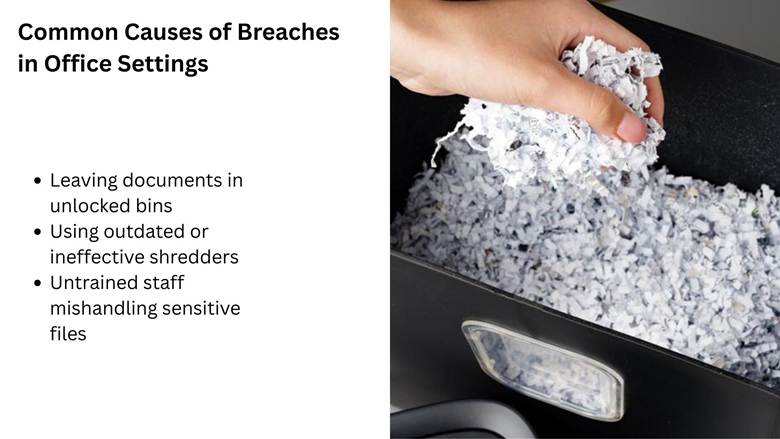
Companies need a clear, well-planned shredding policy. Someone should own document security and plan regular shredding, so sensitive records do not build up in the office. Staff should be trained and know how to dispose of confidential paper.
Proof matters too. A certificate of destruction, kept with your waste paperwork, shows what was destroyed, when and by whom. That evidence helps if a client, an auditor or the ICO ever asks.
How to make a good shredding policy
A good policy covers every document from creation to destruction. Here are the essential steps:
- Identify your documents. Work out which documents contain confidential information and need secure shredding.
- Define retention periods. Be clear about how long each type of document must be kept before it is destroyed.
- Assign responsibility. Choose staff members to manage secure shredding and compliance.
- Use separate confidential waste sacks or bins. Keep confidential paper apart from general office recycling, in a secure room or locked area, so it cannot be mixed up or taken.
- Train your staff. Make sure everyone knows what counts as confidential waste, checks documents before throwing them away, and understands the risks of getting it wrong.
- Review regularly. Check the policy from time to time to make sure it still works and meets current rules.
Do not forget hard drives and other media
Confidential waste is not just paper. Hard drives, USB sticks, phones and backup tapes can hold far more information than a filing cabinet. They need certified erasure or physical destruction, not a paper shredder. See our hard drive shredding and data destruction services, and our guide on how to destroy a hard drive.
Office shredders vs a professional shredding service
In-house shredding may sound cost-effective, but it rarely offers the efficiency and reliability of a professional service. If you do shred in the office, use a cross-cut or micro-cut shredder, which cuts paper both ways into small pieces that are very hard to reassemble. Strip-cut shredders leave long strips that can be pieced back together.
Office shredders also struggle with large volumes and tend to jam. Industrial shredders used by professional companies handle boxes of files, folders and staples with no fuss. A certified provider will also give you proof of destruction, so you can show your documents were disposed of securely.
How EcoGreen’s confidential paper shredding works
- On-site or off-site. We bring industrial shredders to your premises, or collect your paper in secure sacks and shred it within 24 hours at our CCTV-monitored Nottingham facility.
- Free Business Collection. We collect with our own vehicles and staff, so your documents never pass to a third-party courier.
- One-off or scheduled. Book a single clear-out or regular collections on dates that suit you.
- No preparation needed. Folders, staples, paperclips and ring binders can all go into the sacks.
- Certificate of destruction. Emailed after every collection, confirming the number of sacks, the collection date and the shredding date.
- Recycled, not landfilled. The shredded paper is sent for recycling under our zero landfill policy.
- Certified to ISO 27001 (information security), ISO 9001 (quality), ISO 14001 (environment) and ISO 45001 (health and safety), with Cyber Essentials Plus; registered with the ICO and the Environment Agency.
Find out more about our confidential paper shredding service. If you are based in the capital, see our guide to confidential document shredding in London.
What does confidential paper shredding cost?
Most of our clients receive a free service, because the reuse of equipment generates revenue. If the equipment will not cover our costs, we give a quote at booking, based on the type, quality and quantity of equipment, the location and the service level.
Talk to us
Got confidential paper to destroy? Get a free quote or book a collection.
- Call: 033 0124 3053 (Monday to Friday, 9am to 5pm)
- Email: [email protected]
- Online: contact us to request a quote or book a collection.
Frequently asked questions
What is confidential waste?
Any document that identifies a person or reveals sensitive business information, such as payroll records, customer lists, contracts and medical notes. If you would not want a stranger to read it, treat it as confidential.
Where should you dispose of confidential information?
Never in general waste or an open recycling bin. Keep it in a secure, separate sack or bin, then have it shredded by an authorised provider that gives you a certificate of destruction. See our paper shredding service.
Do I have to shred confidential information?
UK GDPR requires you to keep personal data secure until it is destroyed, and your duty of care means passing waste only to an authorised carrier. Secure shredding with a certificate is the simplest way to show you have done both.
Is confidential paper shredding free?
Most of our clients receive a free service, because the reuse of equipment generates revenue. If the equipment will not cover our costs, we give a quote at booking, based on the type, quality and quantity of equipment, the location and the service level.
Do I need to remove staples, clips or folders?
No. Folders, staples, paperclips and ring binders can all go into the sacks.
Is shredded paper recycled?
Yes. After shredding, the paper is sent for recycling into new paper products.
Sources